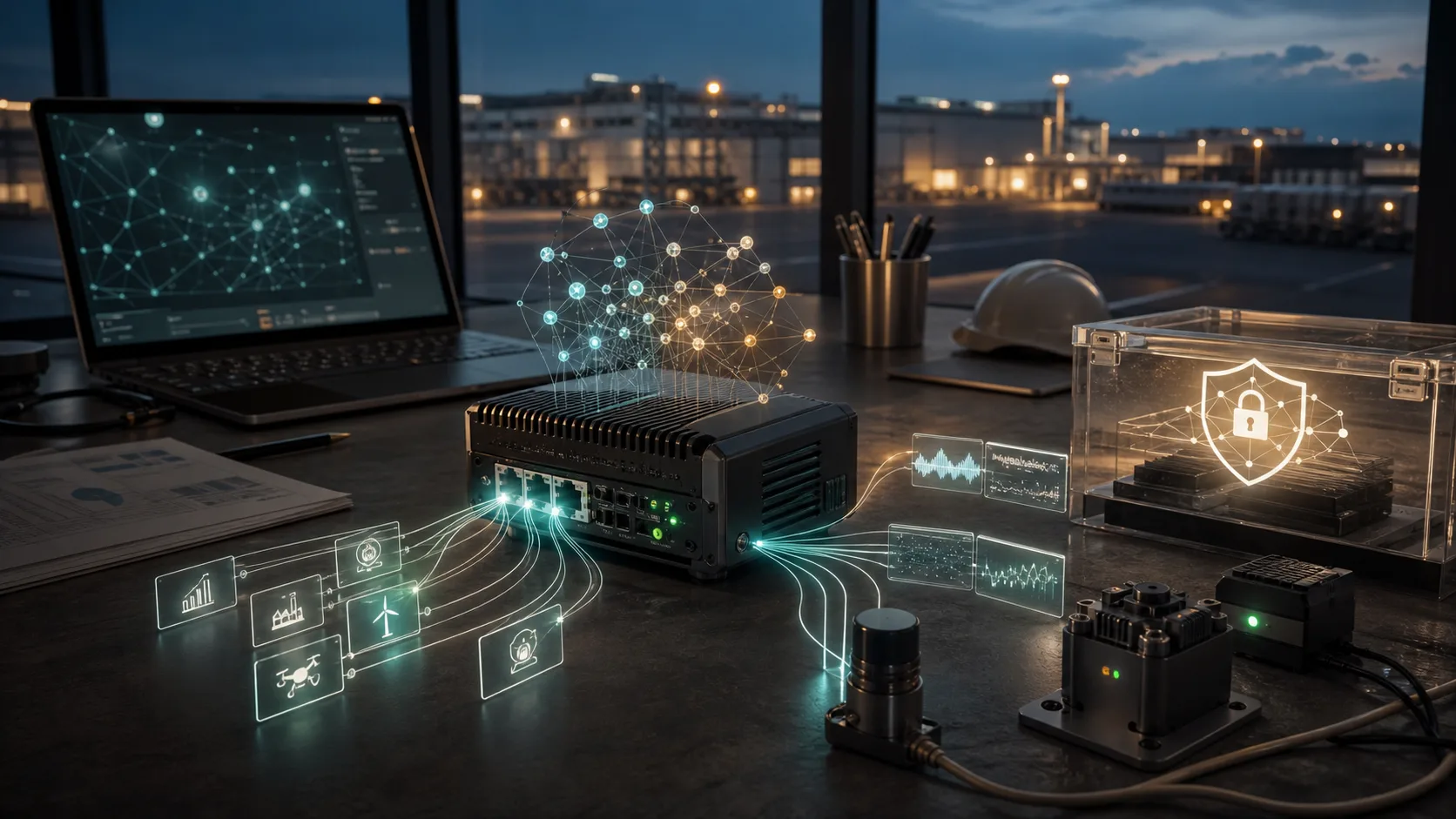
The Edge Problem Is Not Only Inference
Edge AI is usually framed as a model deployment problem. Put a smaller model near the sensor. Reduce latency. Avoid sending every event to a central cloud. Keep operating when the network is slow, expensive, or unavailable.
Those are real requirements, but they are not the whole architecture.
An edge-deployed agent also needs context. It needs to know which assets, products, locations, contracts, procedures, permissions, risks, and outcomes matter for the task it is performing. It needs to write down what it observed or proposed. It needs a way to distinguish local tentative work from shared state. It needs validation feedback before a change affects other systems. It needs provenance, because an autonomous or semi-autonomous action without a trace is not an operational system. It is a liability.
That means the edge problem is not only “where does the model run?” It is also “where does the agent get governed knowledge, and where can it propose change?”
That is where WWKG fits.
WWKG does not need to be the agent runtime. It does not need to replace the model, the orchestration framework, the control loop, or the local application. The stronger pattern is simpler: bring your own agent, connect it to a local WWKG node, and let WWKG provide the semantic data logistics layer around the work.
Bring Your Own Agent
Different teams will use different agents. Some will use IDE agents. Some will use enterprise assistants. Some will use local models. Some will use cloud models through carefully controlled tool calls. Some will build domain-specific workers in ordinary application code and only use language models for narrow steps.
That diversity is a reason to keep WWKG out of the agent-runtime business.
The integration surface should be narrow and explicit. An agent can connect to a local WWKG node through a tool server, MCP service, plugin, skill, SDK, or application-specific adapter. The exact adapter matters less than the boundary it enforces.
The agent should not receive arbitrary access to the enterprise knowledge graph. It should receive:
- scoped graph context for the workspace, use case, and persona;
- the stories that are permitted in that context;
- a local branch where proposed changes can be committed;
- validation feedback from declared shapes, policies, and tests;
- provenance for every proposed change;
- a promotion path from local work to shared branch history.
That is the useful division of labor. The agent reasons and acts through tools. WWKG holds the governed semantic context and records the proposed change path.
This is especially useful at the edge because the local node can be close to the work. It can serve cached graph context, record local branch history, and synchronize meaningful changes when connectivity allows. The agent does not have to treat the central cloud as the only place where knowledge exists.
Local Context Is Different From Local Memory
Many agent systems talk about memory. Usually that means a vector store, a chat transcript, a scratchpad, or a collection of retrieved documents. Those can be useful, but they are weak context for operational work.
Operational context is more structured.
An agent inspecting a production anomaly, a supplier substitution, a field maintenance issue, or a regulatory evidence gap needs to know which part of the business it is acting in. It needs to know which persona it is acting as, which story it is allowed to perform, which outcome defines success, and which concepts or rules apply.
That is why Use Case Trees matter for agent work. A use case is not just a folder of prompts. It can become a graph-native context boundary. A story is not just a paragraph of instructions. It can become a permitted unit of work. A persona is not just a tone of voice. It can describe a real viewpoint, responsibility, language, and skill profile inside the business domain.
At the edge, this matters even more. The agent may not have full access to the enterprise graph at all times. It may only have the subgraph that is relevant to a site, machine, vessel, aircraft, facility, or field team. That is not a defect. It is the point of a data logistics layer: move the right knowledge to the right node, keep the history verifiable, and avoid pretending every decision requires a live round trip to a central database.
The Write Boundary Matters Most
Read-only agent use cases are the easy part. Give the model some context, ask it a question, and return an answer. That can still go wrong, but the blast radius is limited.
Operational agents become interesting when they propose changes:
- create a maintenance observation;
- classify an event;
- flag a policy exception;
- propose a supplier substitution;
- attach evidence to an outcome;
- update a local asset state;
- prepare a change request for review.
Those changes should not land directly in production. They should land on a branch.
The branch is the write boundary. It lets the agent work locally without turning every proposal into shared truth. It creates a history of what the agent did. It allows validation to run while the work is still isolated. It lets a reviewer inspect the diff. It lets automation promote clean changes only through the same kind of merge path that human and pipeline changes use.
This is the core edge-agent pattern:
- Bind the session to a workspace, use case, persona, and story.
- Read local graph context from the nearest WWKG node.
- Commit proposed changes to a local staging branch.
- Validate the branch state against declared rules.
- Iterate locally while warnings remain.
- Synchronize and merge accepted changes when the workflow allows.
The agent may be sophisticated or simple. It may run locally or call a remote model. The safety property does not come from trusting the agent. It comes from keeping context, permissions, writes, validation, and promotion explicit.
Offline Is Not A Binary State
Edge systems are rarely simply online or offline. Connectivity may be available but expensive. It may be intermittent. It may have high latency. It may be usable for small semantic deltas but not for large telemetry streams. It may be suitable for synchronization but not for a tight control loop.
WWKG’s branch and replication model gives architects a better vocabulary for that reality.
A local node can keep working with the graph state it has. A branch can record new observations or proposed changes while disconnected. When connectivity returns, durable branch history can synchronize according to workspace policy. The system does not need to ship a full database snapshot just to communicate what changed. The meaningful unit is the graph change and the history around it.
That distinction is important. WWKG is not a telemetry broker. It is not a replacement for real-time control software. It should not sit inside a safety loop that requires deterministic millisecond behavior unless a domain system has engineered and certified that path.
WWKG is the semantic logistics substrate around those systems. It gives local agents a place to get context, propose graph changes, preserve evidence, and rejoin shared history without pretending the network was perfect.
What The Agent Should See
The cleanest integration is not a giant graph endpoint and a prompt that says “be careful.” The cleanest integration is a tool surface shaped by the use case.
For a bounded story, the adapter can expose:
- the current use case and persona;
- relevant concepts and relationships;
- allowed inputs and expected outputs;
- local branch identity;
- validation warnings;
- diff and provenance for proposed changes;
- merge or handoff status.
The agent sees enough to do the task, not enough to invent a new operating model. If it needs more context, that request can itself be a governed tool call. If it wants to write, it writes to the branch. If it produces a change, the change is inspectable as graph data.
This is where MCP services, plugins, skills, and SDK adapters become practical rather than speculative. They are not the architecture by themselves. They are the connection points that let different agent clients use the same governed knowledge substrate.
The Architecture Claim
The defensible claim is not that WWKG is an Edge AI engine.
The defensible claim is that edge and local agents need a governed semantic substrate, and WWKG is designed to provide that substrate through data logistics primitives: branches, commits, validation, diff, merge, signed history, replication, encryption, and graph-native context.
That is a better fit for how agent ecosystems are evolving. The agent layer will keep changing. Model providers, IDEs, assistants, local runtimes, and orchestration frameworks will continue to compete. Enterprises should not tie their operational knowledge model to one of those surfaces.
They need the knowledge layer to be stable, local-capable, auditable, and governed.
Bring your own agent. Connect it to the nearest WWKG node. Let the agent act through named stories, in a declared persona, against a local branch, with validation and provenance around every proposed change.
That is the data logistics pattern edge AI has been missing.
This article is part of the WWKG article series on semantic data logistics, business intent, and knowledge graph infrastructure for future agentic enterprise systems.