Why This Matters
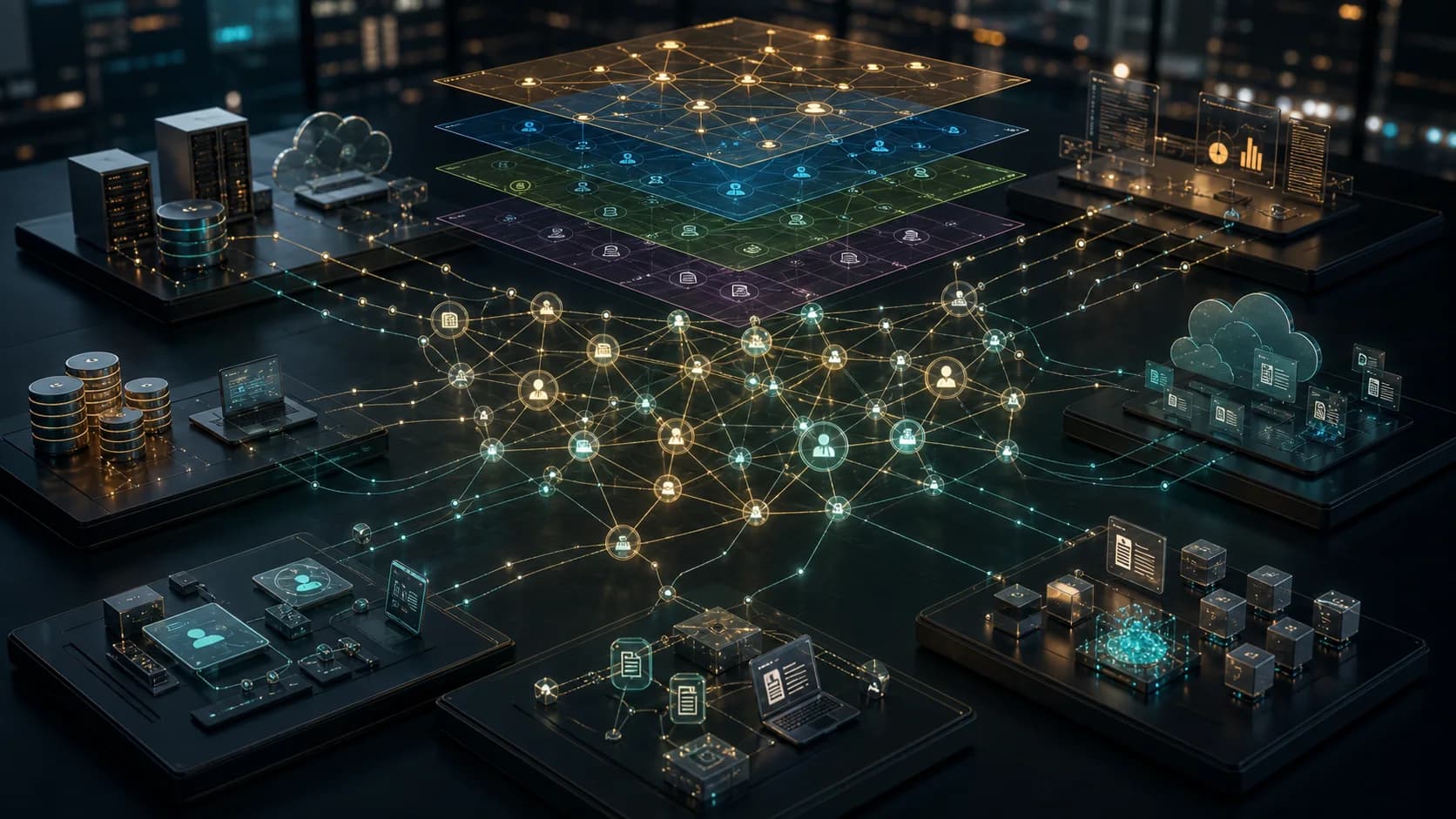
Organizations sit on vast amounts of data spread across CRMs, ERPs, data lakes, and SaaS platforms. Traditional databases store this data in isolated tables optimized for one application at a time. Knowledge graph infrastructure treats relationships between data as first-class citizens, creating a navigable web of meaning that spans systems, departments, and use cases — including the retrieval layer that modern AI agents depend on.
The Technology
What is it?
Knowledge graph infrastructure is the underlying technological framework used to build, store, query, and manage complex networks of interconnected data. Unlike a single database, it encompasses the full stack:
- Graph storage — the engine that persists nodes, edges, and properties in a way optimized for traversing relationships rather than scanning rows.
- Semantic layer — ontologies and schemas that define the categories, rules, and types of relationships allowed in the graph. Think of it as the grammar that ensures every team speaks the same data language.
- Query and interface layer — specialized languages like SPARQL, Cypher, and GQL that let users and AI models ask complex, multi-hop questions across the entire graph.
- Ingestion pipelines — tooling that pulls data from disparate sources, maps it into the graph, and keeps it current.
- Security and governance — encryption, access control, audit trails, and provenance tracking that make the graph enterprise-ready.
How does it work?
A knowledge graph represents information as a network of entities (people, products, transactions, documents) connected by typed relationships (reports-to, contains, purchased, authored). This structure mirrors how domain experts actually think about their data — not as flat tables, but as a web of context.
When a user or an AI agent queries the graph, the engine traverses these relationships to assemble answers that would require complex joins, denormalization, or guesswork in a traditional system. For example:
“Show me every supplier whose components appear in products that failed quality checks in the last 90 days, and flag the ones that also supply our top-revenue customers.”
In a relational database, this requires multiple joins across isolated tables, hand-written SQL, and brittle assumptions about schema. In a knowledge graph, it is a single query that follows the relationships already encoded in the data.
How mature is it?
The concept of representing knowledge as a graph dates back decades — from early semantic networks in the 1960s to the W3C’s RDF standard in 1999 and Google’s Knowledge Graph announcement in 2012. Enterprise graph databases like Neo4j, Stardog, and GraphDB have been in production use for over a decade.
What is new is the convergence of three trends:
- AI demands structured retrieval. Large language models hallucinate when they rely on unstructured text alone. Knowledge graphs provide the verified, structured facts that ground AI outputs — an approach known as GraphRAG.
- Data mesh and federation. Organizations are moving away from monolithic data warehouses toward domain-owned data products. Knowledge graphs provide the connective tissue between domains without requiring a single central database.
- Regulatory pressure. Data lineage, provenance, and auditability are no longer nice-to-haves. Graph infrastructure makes these properties intrinsic rather than bolted on.
Opportunities
-
Breaking data silos. A knowledge graph unifies information from CRM, HR, finance, and engineering systems into a single queryable fabric — without requiring everyone to migrate to the same database.
-
Grounding generative AI. Knowledge graphs provide the “source of truth” that prevents AI hallucinations by forcing models to retrieve verified, structured facts through techniques like GraphRAG.
-
Extensibility. Unlike rigid application schemas, a knowledge graph can add new entity types, properties, and relationships without forcing every domain into a single canonical model. Existing queries still need stewardship, but the graph can carry multiple viewpoints at once.
-
Complex pattern discovery. Graph infrastructure excels at use cases where value lies in the connections — fraud detection, supply chain risk, regulatory compliance, talent mapping, and drug interaction analysis.
-
Operational intelligence. Real-time graph queries power recommendation engines, identity resolution, network monitoring, and impact analysis across interconnected systems.
Challenges
-
Skill gap. Graph query languages (SPARQL, Cypher, GQL) are less widely known than SQL. Teams may need training or tooling that abstracts the query layer.
-
Data modeling effort. Building the ontology — the shared vocabulary and rules — requires upfront collaboration between domain experts and data architects. The payoff is high, but so is the initial investment.
-
Integration complexity. Connecting to existing data sources (relational databases, APIs, streaming platforms) requires ETL pipelines or change-data-capture tooling that maps source schemas into the graph model.
-
Vendor landscape fragmentation. The market is split between RDF / SPARQL systems (semantic web heritage) and property graph / Cypher systems (developer-friendly traversal). Choosing one historically meant giving up the strengths of the other.
-
Scale and performance. Not all graph engines handle billions of edges with sub-second latency. Infrastructure choices around distribution, indexing, and caching matter at enterprise scale.
What to Look For
When evaluating knowledge graph infrastructure for your organization, consider these questions:
-
Query language support. Does the platform support the query languages your team already knows, or will it require a full retraining effort? Can it bridge the RDF/property-graph divide?
-
Data integrity. How does the system ensure that data has not been tampered with? Are there cryptographic guarantees, or do you rely on trust in the operator?
-
Versioning and audit. Can you branch, merge, and time-travel through your data history? Or is every write destructive, overwriting what came before?
-
Security model. Is encryption end-to-end, or does the operator (cloud provider, SaaS vendor) have access to your plaintext data?
-
Distribution model. Can the infrastructure run across multiple locations, work offline, and synchronize without a central server? Or does it depend on a single cluster?
-
AI readiness. Does the platform support structured retrieval for AI agents (GraphRAG), or would you need to build that integration yourself?
This article is part of the WWKG explainer series — plain-language introductions to the technologies and ideas behind modern knowledge graph infrastructure.